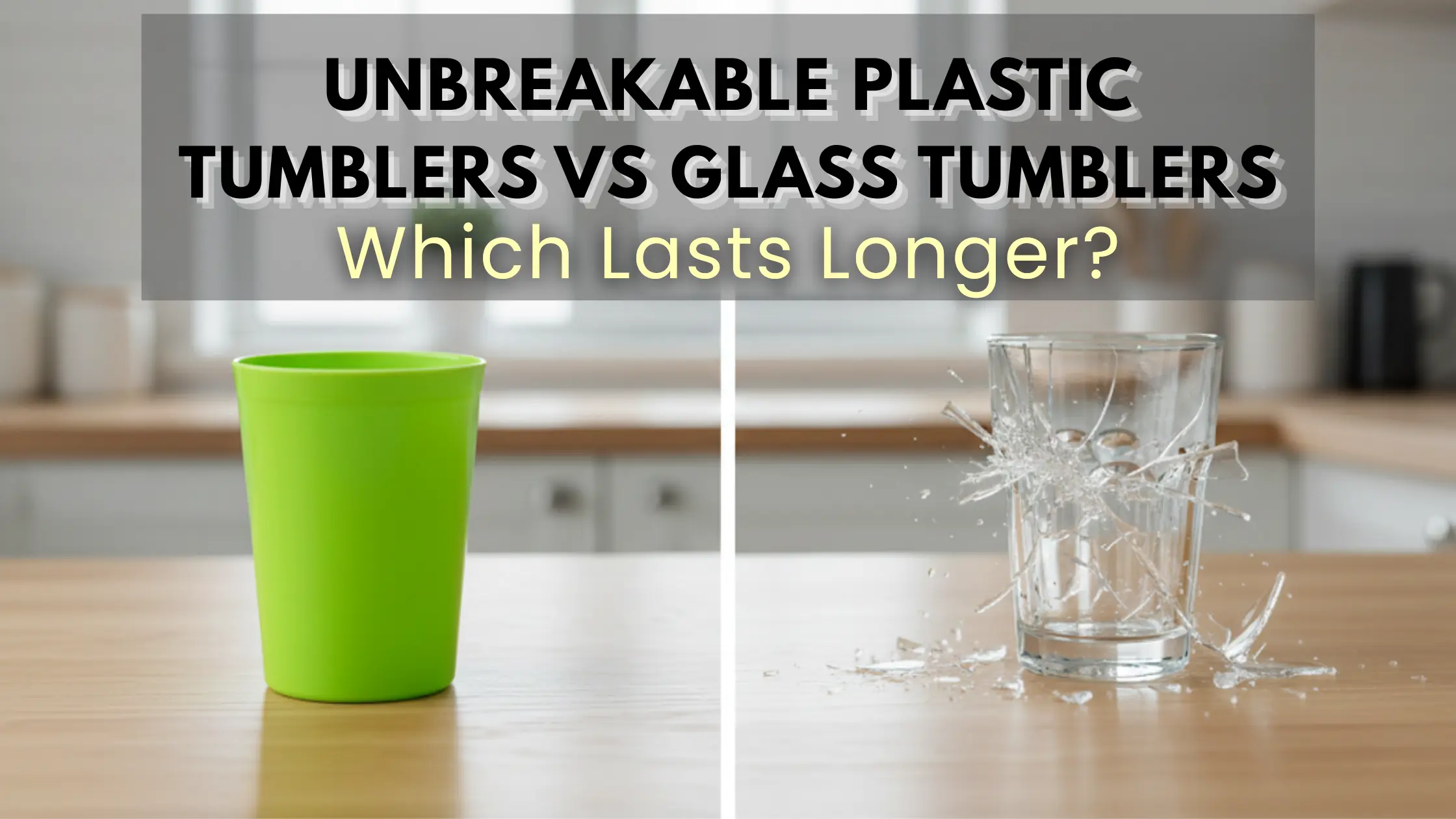
Plastic vs glass tumblers: which is better?
Unbreakable plastic tumblers last significantly longer than glass tumblers in most environments because they possess high impact resistance and do not shatter upon dropping. While glass tumblers are chemically inert, they are prone to thermal shock and mechanical failure. In commercial settings, plastic tumblers typically have an annual replacement rate of 10-20%, whereas glass ranges from 50% to 200%.
What defines the lifespan of unbreakable plastic tumblers?
An unbreakable plastic tumbler, which is a durable alternative to traditional drinkware, has a molecular composition designed for longevity. The lifespan of these vessels is measured not just in years, but in dishwasher cycles and impact events.
Most premium “unbreakable” products are made from Tritan Copolyester or Polypropylene (PP). Tritan, which is a specialized polymer, has a high tensile strength that allows it to withstand significant physical stress without cracking. According to material science studies, a high-quality Tritan tumbler can endure over 1,000 industrial wash cycles before showing signs of “crazing” or cloudiness.
In the current global market, the plastic tumbler segment was valued at approximately $709 million in 2024 and is projected to grow at a CAGR of 7.81% through 2032. This growth is largely attributed to the superior lifespan of engineered plastics in high-use environments like hospitals, schools, and outdoor hospitality venues.
How does glass compare in terms of durability?
A glass tumbler, which is a vessel made primarily of silica, has a brittle nature due to its rigid crystalline structure. While glass is lauded for its scratch resistance and aesthetic purity, its functional lifespan is often cut short by two primary factors: mechanical impact and thermal shock.
Unlike unbreakable plastic tumblers, glass cannot deform to absorb energy. When a soda-lime glass cup hits a hard surface, the energy creates a fracture that propagates instantly, resulting in shattering. Furthermore, glass is highly susceptible to thermal shock the stress caused by rapid temperature changes (e.g., pouring ice water into a glass fresh from a hot dishwasher). This often results in spontaneous cracking, a failure mode that is virtually non-existent in polypropylene or polycarbonate alternatives.
Plastic vs. Glass Tumblers: A Comprehensive Comparison
To understand which material offers better long-term value, we must look at the technical specifications and commercial performance metrics.
Unbreakable Plastic Tumbler vs. Standard Glass Tumbler
- Core Material
- Unbreakable Plastic Tumbler: Tritan, PP, or SAN Plastic
- Standard Glass Tumbler: Soda-lime or Borosilicate Glass
- Unbreakable Plastic Tumbler: Tritan, PP, or SAN Plastic
- Impact Resistance
- Unbreakable Plastic Tumbler: Excellent (Shatterproof)
- Standard Glass Tumbler: Poor (Fragile)
- Unbreakable Plastic Tumbler: Excellent (Shatterproof)
- Annual Replacement Rate
- Unbreakable Plastic Tumbler: 10% – 20%
- Standard Glass Tumbler: 50% – 200%
- Unbreakable Plastic Tumbler: 10% – 20%
- Thermal Shock Resistance
- Unbreakable Plastic Tumbler: High
- Standard Glass Tumbler: Low to Medium
- Unbreakable Plastic Tumbler: High
- Dishwasher Safe
- Unbreakable Plastic Tumbler: Yes (1,000+ cycles)
- Standard Glass Tumbler: Yes (Unlimited, but prone to breakage)
- Unbreakable Plastic Tumbler: Yes (1,000+ cycles)
- Weight
- Unbreakable Plastic Tumbler: Lightweight (Easy to handle)
- Standard Glass Tumbler: Heavy (High fatigue)
- Unbreakable Plastic Tumbler: Lightweight (Easy to handle)
Why are unbreakable plastic tumblers better for high-traffic environments?
In commercial foodservice and outdoor settings, the “lifespan” of a product is often dictated by accidental drops. Unbreakable plastic tumblers offer several logistical advantages that extend their service life:
- Safety in “No-Glass” Zones: Many outdoor patios and poolside bars mandate the use of shatterproof drinkware to prevent hazardous shards from entering public areas.
- Operational Efficiency: When a plastic cup is dropped, the staff can simply retrieve it. A broken glass requires a full “stop-and-clean” procedure, often requiring the disposal of nearby ice or food to prevent cross-contamination.
- Reduced Employee Fatigue: Because plastic has a lower density than glass, it is easier for staff to carry large trays of drinks, reducing the likelihood of fatigue-related drops.
For a deeper dive into the best materials for your business, check out our Commercial Drinkware Selection Guide. You may also want to review the National Sanitation Foundation (NSF) standards for food-safe plastics.
What are the health and safety implications of each material?
A common argument in favor of glass is its chemical inertness. Glass does not leach chemicals and does not absorb odors. However, modern unbreakable plastic tumblers have closed this gap significantly.
Modern polymers like Tritan are strictly BPA-free and BPS-free, meaning they do not contain Bisphenol A or other endocrine disruptors. When maintained correctly, these plastics are as safe as glass for daily hydration. The primary health risk with glass is physical the potential for ingestion of “glass dust” or micro-shards if a rim chips unnoticed. In contrast, the primary risk with plastic is chemical degradation over extreme timeframes, which can be avoided by replacing the vessels every
Is glass or plastic more sustainable for long-term use?
The sustainability debate is complex and relies on a Life Cycle Assessment (LCA).
- Manufacturing Energy: Glass production requires extreme heat (roughly 1,500°C), while plastic molding occurs at much lower temperatures.
- Transport Emissions: Glass is significantly heavier than plastic. This means shipping 1,000 glass tumblers generates roughly 35-40% more CO2 emissions than shipping the same number of unbreakable plastic tumblers.
- Recycling: While glass is infinitely recyclable, its weight makes the “reverse logistics” of recycling energy-intensive. Plastic tumblers made from Polypropylene are part of a circular economy where they can be ground down and repurposed into new durable goods.
According to a study by the Environmental Protection Agency (EPA), choosing a reusable product that lasts for years is always superior to high-turnover items. Because plastic tumblers break less often, you purchase fewer of them over a decade, reducing your total environmental footprint.
Cost Analysis: Which tumbler offers a better ROI?
When evaluating a purchase, the Total Cost of Ownership (TCO) is more important than the initial price tag.
- Initial Investment: A dozen glass tumblers might cost $20, while a dozen Tritan tumblers might cost $35.
- Year 1 Costs: If you lose 100% of your glass inventory to breakage (a common occurrence in bars), your cost doubles to $40. If you lose only 10% of your plastic inventory, your total cost remains roughly $38.50.
- Long-term Savings: By Year 3, the cost of replacing glass typically exceeds the cost of the original plastic investment by 51-60%
This economic reality is why the reusable water bottle market is shifting toward high-tech polymers, with a projected value of $13.72 billion by 2033.
FAQ
Q1: Do unbreakable plastic tumblers get cloudy over time? A1: While all plastics can eventually show wear, high-quality Tritan tumblers are designed to resist “crazing” and cloudiness for over 1,000 dishwasher cycles. To prevent this, avoid using abrasive scrubbers and highly acidic detergents.
Q2: Can glass tumblers be made unbreakable? A2: No glass is truly unbreakable. However, borosilicate glass and tempered glass have higher resistance to thermal shock and impact than standard soda-lime glass, though they still shatter if dropped on hard surfaces like tile or stone.
Q3: Which is better for hot drinks: plastic or glass? A3: For heat retention and safety, double-walled plastic tumblers are generally superior. They provide an insulation layer that keeps the drink hot while the exterior remains cool to the touch, and they won’t crack from thermal shock.